Originals · Feature · Startups & Fintech
Perceptyne is betting that factories want two arms on wheels, not a walking humanoid
The Hyderabad robotics startup's PR-OMNI is a wheeled semi-humanoid with two 7-axis arms, force sensing in every joint and teleoperation for training. What it is, who backs it and what is still unproven.
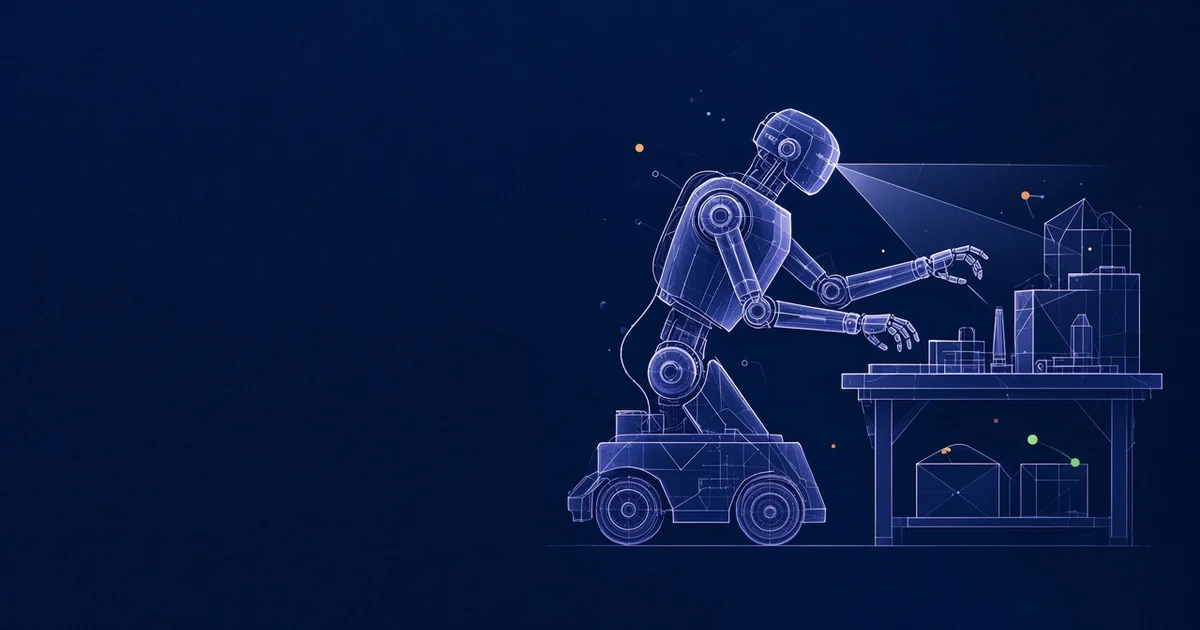
Humanoid robots are the most hyped hardware category of the moment, and most of the attention goes to machines that walk. Perceptyne, a Hyderabad startup, has taken a more practical route. Its newest robot, PR-OMNI, has a humanlike upper body with two arms and a head, but it moves on wheels. The bet is that factories care more about what a robot can do with its hands than about whether it has legs.
What PR-OMNI is
According to the company's product page, PR-OMNI stands 5 feet 2 inches tall and weighs 120 kg. It has two arms with seven degrees of freedom each and a reach of 800 mm, plus a head that moves on two axes. It rides on a holonomic four-wheel drive base that can move in any direction at up to 2 metres per second.
The sensing is where much of the engineering goes. The product page lists dual LiDAR for mapping and localisation, three RGBD depth cameras, force and torque sensing at every joint and tactile sensing. Computing is split between an NVIDIA Jetson Orin and an Intel NUC. The company quotes six hours of runtime from a 3 kWh swappable battery, and the robot can be driven by an operator through VR teleoperation, which is a common way to collect demonstrations to train robot skills. Perceptyne's own software layer is called PhI.
There is one discrepancy worth noting. The product page lists a payload of 5 kg, while a Startuppedia report on PR-OMNI in October put the combined payload at 10 kg. The difference may be per arm against both arms, but the company has not said so in the sources we read.
Startuppedia also reported that Perceptyne builds its actuators and firmware in house and that it can prototype a new task in about a day, using its PR-PhI software layer.
Where it came from
Perceptyne was founded in 2021 by Raviteja Chivukula, Jagga Raju Nadimpalli and Mrutyunjaya Nadiminti, alumni of IIT Madras and BITS, The Times of India reported. It was virtually incubated at T-Hub in Hyderabad and works with automotive and electronics manufacturers.
Before PR-OMNI, the company's main products were industrial arms. When it raised its seed round in October 2024, The Economic Times reported two robots: PR-34D, a dual-arm robot, and PR-9D, a single-arm robot. The company offered them either as a purchase or as a service, a capex or opex choice that matters to Indian factories wary of large upfront automation bills.
Who is paying for it
That seed round was $3 million, co-led by Endiya Partners and Yali Capital, with Whiteboard Capital and angel investors taking part, according to The Economic Times. The paper reported that Perceptyne had earlier raised a $550,000 pre-seed round led by Venture Catalysts at a valuation of $4.5 million.
Endiya later published a note explaining its investment, titled "Why We Invested in Perceptyne: Powering India's Manufacturing Leap with AI-First Robotics".
Why wheels and two arms
Most of the work in an electronics or automotive assembly line happens at waist height on a flat floor. A robot that walks has to spend energy, compute and engineering on balance. A robot on a wheeled base can spend those on manipulation and sensing instead. PR-OMNI's spec sheet reflects that choice: two high-dexterity arms, force sensing in every joint and a long battery life, rather than legs.
The teleoperation and in-house software point to the other half of the bet. Factory robots are traditionally programmed for one task and left there. Perceptyne's pitch, as described by Startuppedia, is a robot that can be shown a new task and switch to it quickly, which is closer to how human workers are redeployed on a line.
What is still unproven
The sources we read describe specs, funding and the company's claims about prototyping speed. They do not give deployment numbers for PR-OMNI, prices, or independent measurements of how fast it learns new tasks or how reliable it is over a shift. Those are the numbers that will decide whether semi-humanoids become a real product category in Indian factories or remain a demo. Perceptyne's seed round is now two years old, and a larger raise would be the next signal to watch.