Originals · Analysis · AI & Tech
Sarvam's Token Factory serves mostly Chinese models from Indian GPUs. Is that sovereign AI?
The IndiaAI Mission's best known model builder has opened an inference platform where six of eight models are Chinese. The backlash has exposed a question India never settled: does sovereignty mean owning the model, or controlling where it runs?
When Sarvam AI was picked under the IndiaAI Mission to build a homegrown foundation model, the company became a symbol as much as a startup. It was the Bengaluru lab that would show India did not have to rent its intelligence from the United States or China. So when Sarvam opened a new product on 16 November and most of the models on its menu turned out to be Chinese, the reaction was loud, fast and split down the middle.
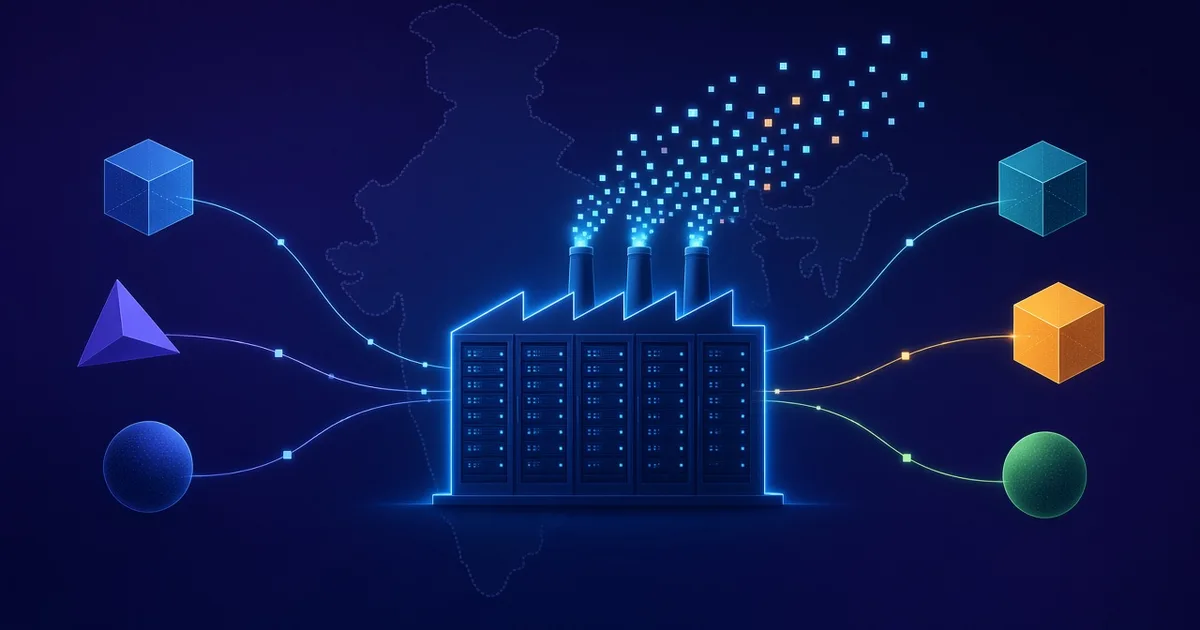
The product is Token Factory, an inference platform. It lets developers and enterprises call several open-weight AI models through one API while the computing runs on Sarvam's GPUs in India. According to The Indian Express, the line-up includes DeepSeek V4.1 Flash, Moonshot AI's Kimi K3.1 Pro, Z.ai's GLM 5.3 and Alibaba's Qwen 3.8 27B, alongside Google's Gemma and Sarvam's own Sarvam 105B. Analytics India Magazine counted eight models, six of them Chinese and one built by Sarvam.
What Sarvam is actually selling
Inference is the unglamorous half of AI. Training a model is a one-time bet; running it every time someone sends a prompt is a daily bill for compute. Companies such as Together AI, Fireworks AI and DeepInfra have built businesses by hosting other people's models, and Amazon offers something similar through AWS Bedrock, The Indian Express noted. Sarvam is entering that market with a local twist: rupee billing and data that stays in the country.
In its launch post, Sarvam says Token Factory serves its own models and leading open-weight models from GPU clusters located in India, and that it runs the same stack on premises for critical institutions. DeepSeek V4.1 Flash launched at an introductory Rs 14 per million input tokens, a price also reported by The Hindu BusinessLine. "We host our own models, and the full range of best-in-class open-weight models, in India," the company said, as quoted by YourStory. Sarvam also claims it already serves more than 450 billion tokens a day through DeepSeek V4.1 Flash, according to The Indian Express and The Hindu BusinessLine. That figure is the company's own and has not been independently checked.
Why the criticism landed
The objection is not about business logic. It is about what public support was meant to buy. The IndiaAI Mission, approved in March 2024 with an outlay of about Rs 10,370 crore, aims to reduce dependence on foreign AI. Sarvam's financial and computing support under it amounts to Rs 246.72 crore according to government disclosures cited by The Indian Express, including a Rs 98.68 crore subsidy for 4,096 Nvidia H100 GPUs that YourStory and Analytics India Magazine reported. The company was valued at $1.5 billion in its last round.
Sanchit Monga, chief executive of Y Combinator backed Runanywhere AI, wrote that he wanted Sarvam "to be the lab that ships frontier research out of India," adding: "After that much capital and subsidized compute, this is not it," as reported by YourStory. Nischal Jain, co-founder of Egma AI, put the feeling more gently, saying Sarvam "was supposed to be India's answer to the US & China," while acknowledging that everyone has to make money.
The timing sharpened the contrast. A day after the launch, Sarvam co-founder Vivek Raghavan told the Bengaluru Tech Summit that India risked becoming a digital colony. "We are exporting data and importing intelligence," he said, according to Business Standard and YourStory. Critics read Token Factory as a version of the same import, only with the servers moved home.
The case for hosting
Defenders argue the critics are mixing up two different achievements. Hemant Mohapatra, a partner at Lightspeed, one of Sarvam's largest investors, wrote on X that global providers are already earning large sums by hosting models, Chinese ones included, in India and serving customers from here, The Indian Express and Analytics India Magazine reported. Technology entrepreneur Nikhil Pahwa wrote that Sarvam is a business that must work in shareholders' interest, calling nationalism "a pitch that got them the GPUs," according to YourStory.
Analysts quoted by The Hindu BusinessLine were more measured. Sanchit Vir Gogia of Greyhound Research said enterprise buyers gain residency, rupee billing and the right model for each task. Kanishk Agrawal, founder of Path in AI Technologies, called hosting foreign models on Indian infrastructure only partial sovereignty and said the revenue should feed India's own AI ecosystem.
Sarvam is not alone, and may not be cheapest
Local inference is becoming crowded. Inc42 noted that Krutrim has hosted DeepSeek models on Indian servers since last year, and that OpenAI and Anthropic now offer in-country inference for some of their models. JarvisLabs, now part of E2E Networks, launched its own token factory about two months before Sarvam, Analytics India Magazine reported. Atharva Ingle, an engineer there, claimed JarvisLabs matched or beat Sarvam on speed and latency for three shared models at lower prices. Those are a rival's own benchmarks, but they raise a fair question about where Sarvam's edge comes from.
Two meanings of sovereignty
Underneath the noise is a real policy question that the IndiaAI Mission has never fully answered. One reading of sovereign AI is ownership: Indian models, Indian training and Indian intellectual property. The other is control: Indian data processed on Indian hardware by Indian operators, whatever the model's origin. The Indian Express framed the debate in exactly these terms, and also noted that local hosting does not resolve every security concern, including model behaviour, software dependencies and access controls.
For banks, insurers and government buyers, that last point matters most. Keeping prompts inside the country solves a residency problem. It does not tell a risk team how a model trained elsewhere will behave on sensitive tasks, or what was learned during its training. Those questions need testing and evaluation, not just a domestic data centre.
What to watch
Hosting and building are not mutually exclusive, and a profitable inference arm could fund the research that critics want. The test, as YourStory put it, is whether Sarvam turns public support and commercial growth into original technology and competitive Indian models. The next few releases of Sarvam's own models, and how prominently they sit on its own menu, will say more about its direction than any argument on X.